 Add to Chrome
 Add to Firefox
 Add to Edge
Adaptive Auto-Harness: Sustained Self-Improvement for Agentic System Deployment on Open-Ended Task Streams
Jun 01, 2026
Auto-harness systems such as A-Evolve, GEPA, and Meta-Harness improve LLM agents by optimizing prompts, skills, tools, memories, and supporting infrastructure from execution feedback, but they are typically evaluated on fixed offline benchmarks. Real deployments instead present open-ended task streams: histories grow without a fixed endpoint, heterogeneous tasks require different harnesses, and problem distributions shift over time. These challenges make a single repeatedly and densely updated harness brittle, causing performance degradation as accuracy peaks early and then declines. This motivates sustained harness construction with task-wise adaptation. We introduce Adaptive Auto-Harness, a framework and system for such streams. The framework decomposes the gap to an oracle harness into evolution loss and adaptation loss. The system addresses these losses with a stateful multi-agent evolver, a harness tree with solve-time routing, and human-steering hooks for cases where history lacks the needed signal. Across prediction-market, security-competition, and event-forecasting streams, Adaptive Auto-Harness outperforms five existing auto-harness baselines and ablations attribute gains to better construction, routing, or targeted human steering. Code is available in https://github.com/A-EVO-Lab/AdaptiveHarness .

Harness Updating Is Not Harness Benefit: Disentangling Evolution Capabilities in Self-Evolving LLM Agents
May 28, 2026LLM agents are increasingly deployed as systems built around editable external harnesses, including prompts, skills, memories and tools, that shape task execution without changing model parameters. Harness self-evolution adapts such agents by updating these harnesses from execution evidence. Yet it remains unclear whether a model's base capability in task-solving predicts its capabilities in harness self-evolution: which models produce useful harness updates, and which actually benefit from them? We analyze two harness self-evolution capabilities: (i) harness-updating, the capability to produce useful persistent harness updates from execution evidence; (ii) harness-benefit, the capability to benefit from updated harnesses during task solving. Our analysis reveals two findings. First, harness-updating is flat in base capability: models from different capability tiers produce harness updates that lead to surprisingly similar gains; even Qwen3.5-9B's updates yield gains comparable to those of Claude Opus~4.6. Second, harness-benefit is non-monotonic in base capability: weak-tier models benefit little from updated harnesses, mid-tier models benefit most, and strong-tier models benefit less than mid-tier. We trace low gains at the weak tier to two failure modes: weak-tier models may fail to activate relevant harness artifacts, or activate them but fail to follow them faithfully. These findings suggest investing capability budget in the task-solving agent rather than the evolver, and targeting harness invocation and long-horizon instruction following in agent training. Our source code is publicly available at https://github.com/A-EVO-Lab/a-evolve/tree/release/harness-evolution.
How Do Latent Reasoning Methods Perform Under Weak and Strong Supervision?
Feb 25, 2026Latent reasoning has been recently proposed as a reasoning paradigm and performs multi-step reasoning through generating steps in the latent space instead of the textual space. This paradigm enables reasoning beyond discrete language tokens by performing multi-step computation in continuous latent spaces. Although there have been numerous studies focusing on improving the performance of latent reasoning, its internal mechanisms remain not fully investigated. In this work, we conduct a comprehensive analysis of latent reasoning methods to better understand the role and behavior of latent representation in the process. We identify two key issues across latent reasoning methods with different levels of supervision. First, we observe pervasive shortcut behavior, where they achieve high accuracy without relying on latent reasoning. Second, we examine the hypothesis that latent reasoning supports BFS-like exploration in latent space, and find that while latent representations can encode multiple possibilities, the reasoning process does not faithfully implement structured search, but instead exhibits implicit pruning and compression. Finally, our findings reveal a trade-off associated with supervision strength: stronger supervision mitigates shortcut behavior but restricts the ability of latent representations to maintain diverse hypotheses, whereas weaker supervision allows richer latent representations at the cost of increased shortcut behavior.
Position: Agentic Evolution is the Path to Evolving LLMs
Jan 30, 2026As Large Language Models (LLMs) move from curated training sets into open-ended real-world environments, a fundamental limitation emerges: static training cannot keep pace with continual deployment environment change. Scaling training-time and inference-time compute improves static capability but does not close this train-deploy gap. We argue that addressing this limitation requires a new scaling axis-evolution. Existing deployment-time adaptation methods, whether parametric fine-tuning or heuristic memory accumulation, lack the strategic agency needed to diagnose failures and produce durable improvements. Our position is that agentic evolution represents the inevitable future of LLM adaptation, elevating evolution itself from a fixed pipeline to an autonomous evolver agent. We instantiate this vision in a general framework, A-Evolve, which treats deployment-time improvement as a deliberate, goal-directed optimization process over persistent system state. We further propose the evolution-scaling hypothesis: the capacity for adaptation scales with the compute allocated to evolution, positioning agentic evolution as a scalable path toward sustained, open-ended adaptation in the real world.
TRAJECT-Bench:A Trajectory-Aware Benchmark for Evaluating Agentic Tool Use
Oct 06, 2025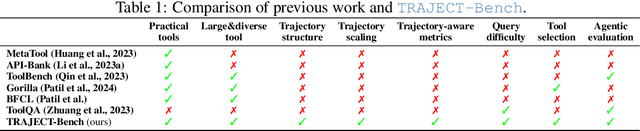
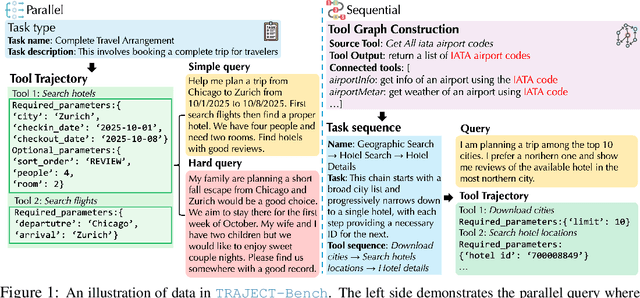
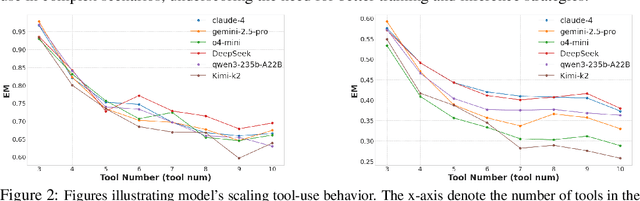
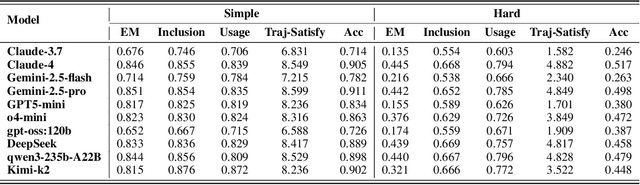
Large language model (LLM)-based agents increasingly rely on tool use to complete real-world tasks. While existing works evaluate the LLMs' tool use capability, they largely focus on the final answers yet overlook the detailed tool usage trajectory, i.e., whether tools are selected, parameterized, and ordered correctly. We introduce TRAJECT-Bench, a trajectory-aware benchmark to comprehensively evaluate LLMs' tool use capability through diverse tasks with fine-grained evaluation metrics. TRAJECT-Bench pairs high-fidelity, executable tools across practical domains with tasks grounded in production-style APIs, and synthesizes trajectories that vary in breadth (parallel calls) and depth (interdependent chains). Besides final accuracy, TRAJECT-Bench also reports trajectory-level diagnostics, including tool selection and argument correctness, and dependency/order satisfaction. Analyses reveal failure modes such as similar tool confusion and parameter-blind selection, and scaling behavior with tool diversity and trajectory length where the bottleneck of transiting from short to mid-length trajectories is revealed, offering actionable guidance for LLMs' tool use.
Explore-Exploit: A Framework for Interactive and Online Learning
Dec 01, 2018


Interactive user interfaces need to continuously evolve based on the interactions that a user has (or does not have) with the system. This may require constant exploration of various options that the system may have for the user and obtaining signals of user preferences on those. However, such an exploration, especially when the set of available options itself can change frequently, can lead to sub-optimal user experiences. We present Explore-Exploit: a framework designed to collect and utilize user feedback in an interactive and online setting that minimizes regressions in end-user experience. This framework provides a suite of online learning operators for various tasks such as personalization ranking, candidate selection and active learning. We demonstrate how to integrate this framework with run-time services to leverage online and interactive machine learning out-of-the-box. We also present results demonstrating the efficiencies that can be achieved using the Explore-Exploit framework.